

Fruit Tree Orchard
Section Menu
Behind the Smiths Falls Heritage House Museum you will find our Fruit Tree Orchard.
The fruit from these trees are for public consumption and we encourage the public to take the fruit they need for fresh snacks, baking, cooking and other cullinary uses. Please be mindful of the remaining fruit and leave lots for others.
When the museum first opened its doors in 1981, our original orchard consisted of three McIntosh apple trees, two Northern Spy apple trees, one Pippin apple tree and one Snow apple tree. As the years march forward, the Snow tree passed away and one McIntosh and one Northern Spy are in recovery from a near-death experience.
We were fortunate enough to recieve the Edible Trees Grant from Trees Canada in 2025, sponsored by Enbridge Gas. With this grant nine new fruit trees were planted: three Bosc pear trees, two Gravenstein apple trees, one Empire apple tree, one Jonathan Red apple tree, one Gala apple tree and one Jonagold apple tree. We also planted a Red Currant bush, with the hope of expanding our berry options in the future.
A map of where each fruit tree is located can be found below.
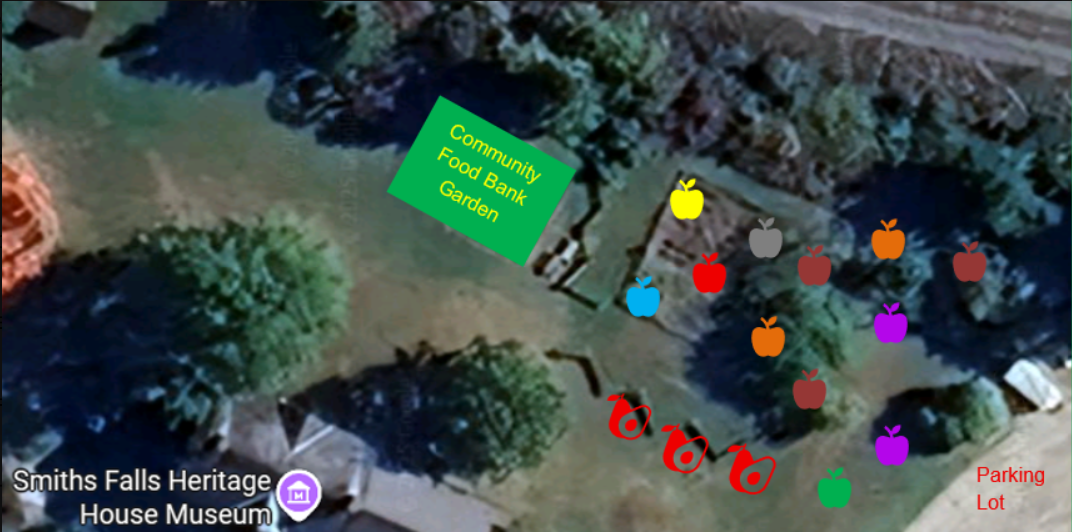
 - Bosc Pears
 -Gravenstein Apples
 -Empire Apples
 -Jonathan Red Apples
 -Jonagold Apples
 -Gala Apples
 -McIntosh Apples
 -Northern Spy Apples
 -Pippin Apples
Some of our apple varieties come up from the United States, just like many of the founders of our town. Abel Russell Ward and Ebeneezer Frost are two of many examples of our American born founders. Our specific Pippin Variety and our Jonathan Red most likely come to us from New York, like town founder and Rideau Canal engineer James Simpson. Northern Spy apple trees also come from New York, though the name reminds us of the namesake of Smiths Falls. Thomas Smyth was a United Empire Loyalist spy during the American Revolution and was granted 400 acres of land that would become Smyth’s Falls (and now Smiths Falls). In the late 1960’s in New York, the Empire and Jonagold apples became available; right around the same time that the Hershey factory settled in as a cornerstone of the Smiths Falls community. Like the chocolate produced, the apples are sweet and addictive.
Some of our varieties are quite old, hailing from overseas. The Bosc Pear and Gravenstein Apples came to the United States in the early 1800’s, around the same time many Irish immigrants came to Smiths Falls for work on the Rideau Canal. Another is a newcomer, also from overseas. The Gala apple comes from New Zealand and was introduced publicly in 1960. During this time, Smiths Falls was introducing North America to many overseas musical phenomena thanks to the RCA Record Plant being at its height.
One of our cultivars originate here in Ontario, Canada, being a longstanding Canadian staple for much of recent history. McIntosh apples were originally grown in 1811 in Dundela, around an hour away from Smiths Falls, and are often called the national apple of Canada. They have worked their way into many local family recipes.
Try this recipe from the 1911 Smiths Falls Cookbook!
Recipe courtesy of Mrs. W. E. McGillivray.
Apple Pie
“Line a deep pie plate with a good paste. Fill with sliced apples; take a cup of sugar mix well with 1 dessertspoon of flour, a little grated nutmeg, half a teaspoon of cinnamon and sprinkle over the pie. If you want a very rich pie dot with small bits of butter. Put on top crust, wet the edges of under crust, pinch the top one upon it closely to prevent juice from oozing out. Bake in a good hot oven. Cut a few openings in top crust to allow steam to escape.”